This year, my first full one back in Paris, I returned to regular cinema-going for the first time in seven years, which no doubt had an influence on the type of films I watched. It was a decent enough of a year for films (better than 2022 for me, though I never got around, for various reasons, to doing a write-up 12 months ago). Not sure if there was a “theme” as such, though the shadow of the 1980s did seem to hang over a lot of the better film I saw.
1. Pacifiction (Pacifiction – Tourment sur les îles) — Albert Serra (France/Spain/Portugal/Germany) 165 mins
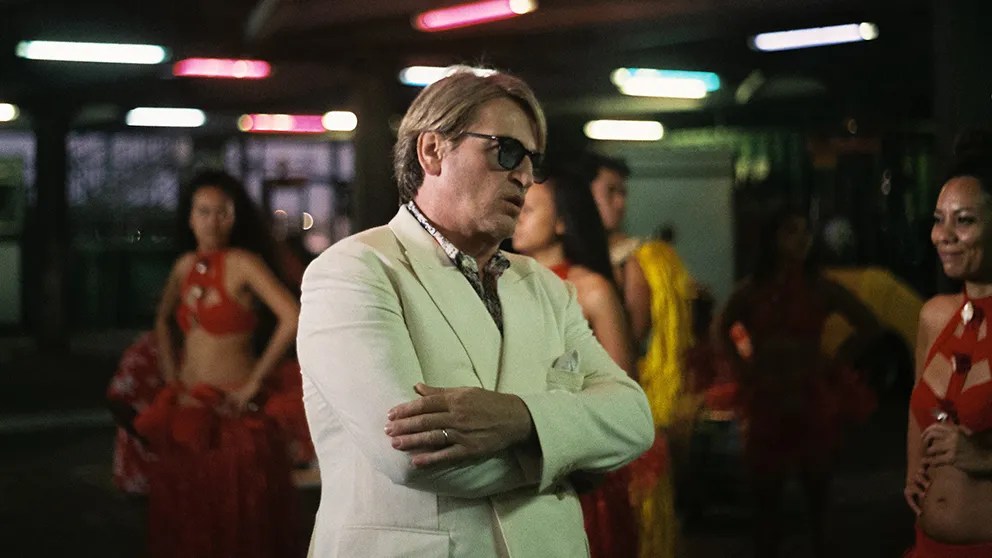
The excellence of so much recent French cinema relies heavily on the strength of the acting, and there are few exponents as brilliant these days as Benoît Magîmel, who has transformed himself into an irresistibly demotic presence. A handsome sometime leading man when he was younger, Magîmel has made the most of his middle-age spread to become a more gregarious and wonderfully unselfconscious actor. Even in so-so fare like Omar la fraise, he is fantastic, outshining even the brilliant Reda Khateb. In Albert Serra’s South Seas espionage drama Pacifiction, he carries the entire film, appearing in almost every scene as a harassed consul, with an uncanny ability to converse naturalistically, as if he is someone who briefly comes into your earshot as you turn a street corner. There is an astonishing evenness and consistency to his performance and his character is also engaging and affable.
The Catalan Serra, who is best known for recondite painterly historical frescos, centred on figures such as Louis XIV and Casanova, takes a somewhat baffling but fascinating turn here into a far-right political intrigue in Tahiti. The Pacific island here is not the exoticized idyll of randy 19th-century consumptives such as Gauguin and Robert Louis Stevenson, but a more mundane, put-upon place, where the minutiae of local politics and horse-trading are the bread and butter of daily life.
Underpinning the languid humid drama are rumours of some sort of coup d’état related to France’s nuclear arsenal, which has a sorry history in Polynesia. It’s a familiar sort of lurch into genre territory that French films (and novels) often find irresistible and here it has the air of a pretext (though given that aforementioned nuclear history, it’s not all that fanciful). If you come for the spy shenanigans you might be sorely disappointed, but you’ll probably be happy enough with the strangely wistful drama ballasted by one of the finest, most minutely calibrated performance in years.
2. Tár – Todd Field (United States) 158 mins
There are many who hate Tár, which I get, as I wasn’t too gone on it myself on first viewing. I found the whole thing arch and pretentious, particularly the lengthy fatuous public interview with New Yorker critic Adam Gopnik that takes up much of the first act, not to mention Cate Blanchett’s highly mannered performance. It was all a bit much.
I’m not sure why I decided to give it another go but I did. And then it clicked. Once you were under the hood, enveloped in the carapace of the film’s all-too-knowing drama, it all made sense. From the inside looking out, you felt like an initiate and enjoying the fact greatly. It’s probably like the sensation when the Scientologists finally get to you and you become a true believer.
Suddenly, Blanchett was a credible figure, a patrician martinet trying just a little too hard to make it all seem effortless. Here was a protagonist who you could perfectly imagine having sufficient enemies to bring her down in a hail of accusations and suppositions. The vulnerability and the cracks in the edifice of supreme confidence are one of the many pleasures of this strangest of mainstream films, made all the stranger by the fact director Todd Field had, till now, turned out only bland middlebrow Oscar fodder such as In the Bedroom and Little Children. Whatever elixir of life Mr Field secured to make something so ontologically distinct from those efforts, I want some of it.
The film also had a pleasing aura of postmodern mystique surrounding it. Some viewers less up to date with the world of classical music were irked when their post-viewing Google searches revealed Lydia Tár was not a real person; the family of Leonard Bernstein (no doubt enjoying all the attention, what with Bradley Cooper’s Maestro too) interjected in a letter to The New Yorker, rebutting Todd Field’s claim that Tár could not have been a student of Bernstein’s. (Maybe Field wasn’t really in charge of the film after all, being merely a proxy for some higher power?) An attractive theory also spread on internet forums that only the third act of the film is the reality and everything till then is either a dream or fantasy. It’s easy to see why some people might hate this sort of carry-on but when you find it enjoyable, it is a lot of fun.
3. Anatomy of a Fall (Anatomie d’une chute) – Justine Triet (France) 152 mins
Justine Triet’s fourth feature was a somewhat surprising Palme d’Or winner at Cannes and was an unexpected change in tone from her fairly breezy, if competent, preceding work, such as In Bed With Victoria and Sybil. This forensic courtroom drama is a gripping exploration of truth and fiction and the cleavages between intent and effect that determine guilt or innocence. It is one of a raft of magisterial recent French courtroom films such as Alice Diop’s Saint Omer and Cédric Kahn’s The Goldman Case (which also stars Anatomy of a Fall screenwriter, and Triet’s husband Arthur Harari), all of which will probably be arresting viewing for English-speakers misled by Anglophone media who blithely assert there is no provision for presumption of innocence in the French legal system.
Sandra Hüller plays a German writer living in France (also named Sandra) accused of killing her husband (Samuel Theis), who fell from the balcony of their Grenoble chalet following an argument. The trial comes as a bit of a surprise as there is little suggestion in the film’s opening act that it might have been anything other than an accident but it soon becomes clear that Sandra’s freedom will rely on the strength of her defence (Swann Erlaud). Anatomy of a Fall (its title a nod to Otto Preminger’s 1959 courtroom drama) is not however a stirring tale of human fortitude under pressure but rather an exploration of judicial ambiguity and a stormy marriage strained by professional jealousy (Sandra is a highly successful writer whereas Samuel is not).
Triet might have called once again on her usual leading lady, the highly bankable (in French-speaking markets at least) Virginie Efira but, excellent as Efira is, she is too much a girl-next-door for this role. Hüller is a pricklier, more rebarbative presence and also speaks French as a third language, which provides an extra layer of interference in the mix here, as the defendant flits from French to English and back despite being warned to stick to French. Antoine Reinartz, previously seen in another Palme d’Or-winner, Robin Campillo’s BPM (Beats per Minute), also deserves mention for his performance as the fearsome prosecutor, who bears his teeth and attacks at the merest sign of vulnerability.
4. The Plains — David Easteal (Australia) 179 mins
The Plains is very much a “hear me out” sort of film. I’ll start by saying it’s almost entirely filmed from the back seat of a car, and lasts three hours and the action is all conversations the driver Andrew (Andrew Rakowski), an unremarkable and undistinguished middle-aged lawyer in the Melbourne suburbs, has on his commute home every evening, either on the phone with his wife or his mother, who is in an old’s folks’ home, or with a younger colleague David (played by the film’s director David Easteal), to whom he occasionally gives a lift.
If you’re still with me, Easteal’s film is one of the year’s unexpected delights: like most great experimental narrative art, it is at its heart brilliantly accessible storytelling. The conversations are banal in the extreme yet gripping, perhaps because there is the sense of eavesdropping that makes you want to learn more, in the same way that a conversation at a neighbouring table in a bar or restaurant starts off annoyingly intrusive and then becomes compelling, to the point you hope you can stay around long enough for the whole chat.
There is also a frisson of mystery in the film’s structure: is it a documentary or is it fiction, or an artful conflation of the two? Andrew, even though we rarely get to see anything other than the side of his head, is sketched out into an improbably interesting character – a sort of Everyman Roy Hodgson. In a strange way, The Plains is a companion piece to the very different Fisk, Kitty and Penny Flanagan’s hilarious sitcom, also set in a suburban Melbourne law office. Each in their own way is a heartwarming celebration of ordinary people and everyday life.
5. Close Your Eyes (Cerrar los ojos) — Víctor Erice (Spain/Argentina) 169 mins
Víctor Erice’s films used to come along at such long intervals – generally a decade or so apart – that they were regarded as rare treasures. His fourth feature Close Your Eyes arrived this year after a 31-year hiatus, instantly sending the value of this gem soaring. Erice’s absence from mainstream filmmaking is priced into his latest, potentially last feature (the Spaniard is now 83, his career having begun in the dying days of the Franco regime). Manolo Solo plays Miguel Garay, a world-weary and impoverished filmmaker (with an air of Erice himself) who tries to track down his former leading man Julio Arenas (José Coronado), who walked off the set of a film he was directing decades earlier and disappeared.
Close Your Eyes is an elegant, straightforward drama about friendship and loss but it’s also a testimony to the inherently spectral nature of filmmaking (there is an extra frisson of the uncanny in Arenas’s daughter Ana being played by Ana Torrent – who was given her acting debut as a child, also playing an Ana, by Erice in 1973’s The Spirit of the Beehive). The film also evokes an unsuccessful detour in Erice’s career, his attempted adaptation in 1999 of Juan Marsé’s novel The Shanghai Spell, which he was fired from and replaced by Fernando Trueba.
Had Erice continued on that production, he would have maintained his one-film-per-decade output. The rushes from Garay’s own truncated production have a similar air of what might have been, which is further emphasised by the sorry state of his missing star once he turns up. Erice and the late Iranian director Abbas Kiarostami collaborated on a fascinating series of short films for the Pompidou Centre in 2006, in which the two “corresponded” via an exchange of imaginary messages set off to sea in a bottle. Close Your Eyes carries a comparative melancholy charge of lost opportunity and a buried past and, if it proves to be Erice’s final film, will be a fitting swan song.
6. Afire (Roter Himmel) — Christian Petzold (Germany) 103 mins
Petzold returns to one of his favoured settings – Germany’s Baltic coast – for this eery variation on the holiday-in-the-country film. Friends Felix (Thomas Schubert) and Leon (Langston Uibel) disembark at Leon’s mother’s holiday home, only to find there is a cuckoo in the nest – seasonal ice cream vendor Nadja (Paula Beer). Felix in particular is put out as he has hoped to finish his novel, but his irritation is soon displaced by infatuation with the supremely laid-back Nadja, whom he treats condescendingly until he learns, to his surprise, that she is in the midst of a literature PhD.
The idyll, fractured from the very first scene, when Felix and Leon’s car breaks down a few miles from its destination, is further threatened by forest fires that redden the sky (as alluded to in the film’s original title) and which gain on the house and its surroundings. Felix is a magnificent creation, probably the most unprepossessing on-screen hero since Paul Giamatti’s Miles in Sideways, his literary talent and his libido cruelly stifled to an equal degree. He walks around with mournful bumptiousness, bearing a physical resemblance to the great depressive comic novelist, B.S. Johnson (there is also a reference to another Johnson, the dissident GDR writer Uwe, whose old hotel room in Ahrensdorp, now named in his honour, Felix briefly considers taking to flee the distractions at the house).
This is sharply contrasted to the cheerfulness of Nadja, who is keen to spend her summer living her best life, as the kids say, and Leon, who manages to put together a promising portfolio with enviable ease, while also getting laid a lot more than Felix. The fire that lies at the central conceit (Afire is the middle part of a loose trilogy of the elements, after the aqueous Undine) might seem fanciful at such a latitude in this day and age but, with global warming, it could well become a common occurrence. That itself is enough to bequeath an extra layer of dread on this well-wrought chamber piece.
7. Do Not Expect Too Much from the End of the World (Nu aștepta prea mult de la sfârșitul lumii) – Radu Jude (Romania/Croatia/France/Luxembourg) 163 mins/The Potemkinists (Potemkiniștii) (Romania) 18 mins
The great chameleon of contemporary Romanian cinema Radu Jude returns to the world of commercials that featured in his first film The Happiest Girl in the World for this bracing satire on filmmaking, capitalism and Romanian society. Angela (Ilinca Manolache), an overworked production assistant, drives around the country collecting testimonies from injured workers for a workplace safety video her employer has been commissioned to make for an Austrian insurance multinational. On the way, she records intermittently funny TikToks, in which she plays a foul-mouthed male youth attempting to surf on the viral wave of Romania’s most notorious expatriate Andrew Tate.
Interlarded with all of this are images from Lucian Bratu’s 1981 film Angela merge mai departe, about a woman taxi driver in Bucharest (also called Angela), who appears to be, in later life, one of the people the younger Angela calls to. Angela also calls to a friend who is working on a film by Uwe Boll, the laureate of terrible contemporary European cinema, who relishes playing up his reputation here. At the other end of the scale of excellence, we see Nina Hoss (last seen in Tár) as the marketing director of the insurance company that is attempting to show its most caring face to the world.
Do Not Expect Too Much from the End of the World, its title coming from a line by the sardonic Polish aphorist Stanisław Jerzy Lec, is a bonkers puzzle of a film, with scattershot targets for its undisciplined barmy satire. It is also the work of a director who is equally at home examining the Romania of today as its past. Also excellent is Jude’s short The Potemkenists, a lucid light comedy about a sculptor trying to convince a local bureaucrat to fund the restoration of a Ceauşescu-era monument to the Potemkin mutineers, who were given political asylum in Romania in defiance of the Tsar.
8. El Conde – Pablo Larraín (Chile) 110 mins
The notorious Augusto Pinochet escaped justice in his lifetime, dying in his bed in 2007 before criminal proceedings could be brought against him. The court of history is likely to be a lot more damning to his name but even that ill repute is put in the ha’penny place by Pablo Larraín’s portrayal of him in El Conde, which gives us Pinochet as a trans-generational vampire who first reared his head in the pre-French Revolution army of Louis XVI. Larraín, who is incapable of making a bad, much less a boring, film, casts Pinochet as a ghoul at once disconsolate and ruthless and his venal bourgeois offspring as having a vested interest in blocking any reappraisal of the man’s villainy.
For good Grand Guignol measure, Margaret Thatcher is thrust forward as Pinochet’s Mammy, in a sleight of hand that is so outrageously hilarious as to be irrefutable. Much as an 18th-century Irish bishop once said of the contemporary hit that was Gulliver’s Travels that he “wouldn’t believe the half of it”, historians in the distant future might feel the need to clarify that the historical Pinochet was not quite the man made famous by El Conde, but it will be much too late. The man has been well and truly murdered here, a stake rammed into his rancid heart. And all so entertainingly too.
9. Indiana Jones and the Dial of Destiny — James Mangold (United States) 154 mins
There’s a lot to be said for going through life with lowered expectations, and this fifth instalment in the Indiana Jones franchise was greatly improved for me by none-too-elevated hopes. Steven Spielberg didn’t seem overly enthused either, abjuring directing duties for the first time in the series, and the forgettable mess that was The Kingdom of the Crystal Skull (2008) suggested that Indy was sputtering to a halt. It didn’t look likely that journeyman director James Mangold would do much to reignite the flame but there was a surprise awaiting us.
While the screenplay, written by Mangold and David Koepp along with the Butterworth brothers, Jez and John-Henry, does a decent job of prolonging the Jones story into the 1960s and the era of the moon landing (and the final act is unexpectedly moving), The Dial of Destiny excels in the most important area: action. From the moment Indy taps on a car window and then punches the Nazi occupant when it is rolled down, the film is a rollercoaster of brilliantly mounted sequences and chases, and it is greatly enhanced in the form of Mads Mikkelsen, a vintage baddie. One thing you do realise is how much better the Indiana Jones movies are when there are Nazis involved.
Harrison Ford, who looked somewhat brow-beaten in the last episode, is an engaging if crotchety presence here, and is unexpectedly reunited with John Rhys-Davies (giving brownface one last go for old time’s sake as Sallah) and Karen Allen (Marion). Only Phoebe Waller-Bridge appears shoe-horned into proceedings, striking an at times discordant note as Indy’s hooray-henry goddaughter, Helena Shaw. An action film that stands apart from the majority of drab fare in that genre and gives a satisfactory conclusion (assuming it is a conclusion) to an intermittently enjoyable franchise.
10. The Animal Kingdom (Le Règne animal) – Thomas Cailley (France) 128 mins
Thomas Cailley’s second feature, and his first in almost a decade, is an unusual confection by the standards of French cinema, blending social drama and fantasy. Romain Duris plays a father of a teenage boy (Paul Kircher) who, like his mother previously, has been stricken by a mysterious endemic disease that causes humans to mutate into animals (in his case, a lizard).
The film portrays a French society that is struggling to come to terms with the new beasts in its midst, veering between sympathetic tolerance and moral panic. Most interesting is how the mutants are given their own suivi médical, treated with the utmost seriousness by the French healthcare system. The balancing act between naturalism and the fantasy world is finely maintained and the acting excellent. Duris has been around seemingly forever but this is the first time I can recall him playing a father, while up-and-coming star Kircher, son of Kieślowski alumna Irène Jacob, has a maturity beyond his years as the youngster who is undergoing a traumatic physical transformation. For all its grounding in realism, The Animal Kingdom bears more than a passing resemblance to intelligent low-key Hollywood films of the 1980s such as Flight of the Navigator, and its all the better for that.
Also good
About Dry Grasses (Kuru Otlar Üstüne) – Nuri Bilge Ceylan (Turkey/France/Germany) 197 mins
All the Beauty and the Bloodshed – Laura Poitras (United States) 122 mins
Anselm (Anselm – Das Rauschen der Zeit) – Wim Wenders (Germany) 93 mins
A Real Job (Un métier sérieux) – Thomas Lilti (France) 101 mins
Barbie – Greta Gerwig (United States/United Kingdom) 114 mins
Cocaine Bear – Elizabeth Banks (United States) 95 mins
Corsage – Marie Kreutzer (Austria/Luxembourg/Germany/France) 113 mins
Fallen Leaves (Kuolleet lehdet) – Aki Kaurismäki (Finland/Germany) 81 mins
Holy Spider (Ankabut-e moqaddas) – Ali Abbasi (Germany/Denmark/France/Sweden) 117 mins
How to Have Sex – Molly Manning Walker (United Kingdom) 91 mins
In Front of Your Face (Dangsin Eolgul Ap-Eseo) – Hong Sang-soo (South Korea) 85 mins
Kidnapped (Rapito) – Marco Bellocchio (Italy/France/Germany) 125 mins
Killers of the Flower Moon – Martin Scorsese (United States) 206 mins
Love Life – Koji Fukada (Japan/France) 123 mins
Master Gardener – Paul Schrader (United States) 111 mins
May December – Todd Haynes (United States) 117 mins
North Circular – Luke McManus (Ireland) 80 mins
One Fine Morning (Un beau matin) – Mia Hansen-Løve (France/Germany) 112 mins
Oppenheimer – Christopher Nolan (United States/United Kingdom) 181 mins
Our Body (Notre corps) – Claire Simon (France) 168 mins
Paris Memories (Revoir Paris) – Alice Winocur (France) 105 mins
Past Lives – Celine Song (United States) 106 mins
Return to Seoul (Retour à Séoul) – Davy Chou (France/Germany/Belgium/Qatar/Cambodia) 119 mins
Showing Up – Kelly Reichardt (United States) 108 mins
Strange Way of Life (Extraña forma de vida) – Pedro Almodóvar (Spain) 31 mins
The Boy and the Heron (Kimitachi wa Dō Ikiru ka) – Hayao Miyazaki (Japan) 124 mins
The Breaking Ice (Rán dōng) – Anthony Chen (China/Singapore) 97 mins
The Crime Is Mine (Mon crime) – François Ozon (France) 102 mins
The Fabelmans – Steven Spielberg (United States) 151 mins
The Beasts (As bestas) – Rodrigo Sorogoyen (Spain/France) 137 mins
The Goldman Case (Le procès Goldman) – Cédric Kahn (France) 115 mins
The Holdovers – Alexander Payne (United States) 133 mins
The Killer – David Fincher (United States) 118 mins
The Nature of Love (Simple comme Sylvain) – Monia Chokri (Canada) 110 mins
The Night of the 12th (La Nuit du 12) – Dominik Moll (France/Belgium) 114 mins
The Rapture (Le Ravissement) – Iris Kaltenbäck (France) 97 mins
The Quiet Girl (An Cailín Ciúin) – Colm Bairéad (Ireland) 94 mins
The Three Musketeers: D’Artagnan (Les Trois Mousquetaires: D’Artagnan) – Martin Bourboulon (France/Germany/Spain/Belgium) 121 mins
The Wasteland (Dashte khamoush) – Ahmad Bahrami (Iran) 102 mins
Wild Flowers (Girasoles silvestres) – Jaime Rosales (Spain/France) 107 mins
Yannick – Quentin Dupieux (France) 67 mins
You Hurt My Feelings – Nicole Holofcener (United States) 93 mins
 OLIVER FARRY